
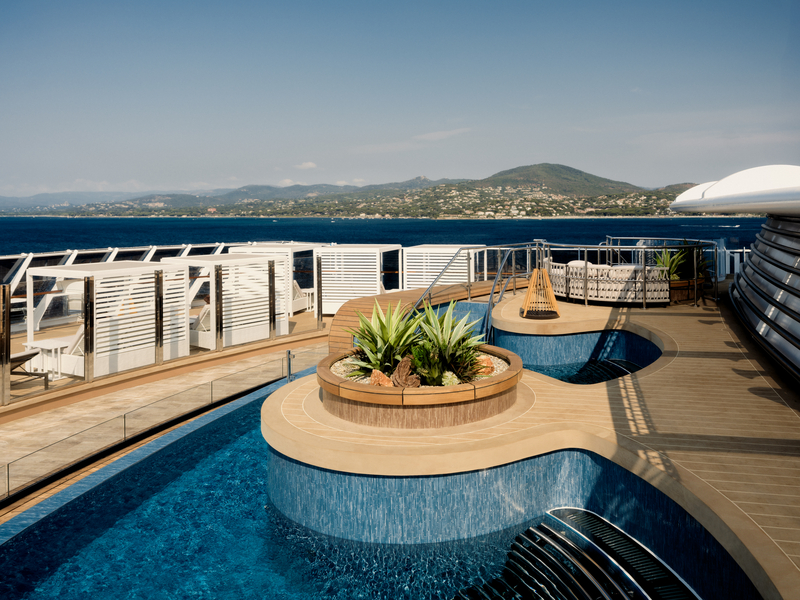
I just stepped off Norwegian Prima after a week sailing in The Haven, and somewhere between enjoying the private Haven pool and venturing out into the rest of the ship, I started thinking about how much my idea of “luxury cruising” has changed.
Over the last few years, I’ve sailed just about every version of it — big ships, private suite-level experiences, Virgin Voyages at RockStar level, Explora Journeys, and The Ritz-Carlton Yacht Collection. And I’ve realized there really isn’t one “best” way to sail. A huge ship can be fantastic. A smaller ship can completely spoil you. And sometimes paying for a suite on a big ship gives you the best of both worlds. It really comes down to what you want from that particular trip.
The Big Ship Advantage
There is definitely something to be said for a big ship. Restaurants everywhere, bars everywhere, shows, live music, casinos, spas, activities — and on Prima, even a racetrack. You can spend a week onboard and still not do everything.
For a group, a celebration or a trip where everyone wants something different, that can be a huge advantage. One person wants the spa, someone else wants a show, another wants a steakhouse, and someone else wants to sit at a bar and do absolutely nothing. Everyone can have their own vacation and still meet for dinner.
But there’s a flip side: more people means more people. Elevators can be busy, popular restaurants and shows require some planning, and the pool deck can feel crowded. Depending on the ship and sailing, there can simply be a lot happening around you. Sometimes that’s exactly the energy you want. Other times, you want to escape it.
Enter the “Ship Within a Ship”
This is where experiences like The Haven by Norwegian get interesting. The Haven on Prima is essentially a private enclave within a much larger ship, with its own restaurant, lounge, pool, sundeck and dedicated concierge and butler service.
You can spend the morning somewhere quiet, have breakfast without fighting a crowd, sit by a private pool, and then walk downstairs and suddenly have an entire resort’s worth of restaurants, bars and entertainment available to you. That combination is pretty compelling, especially for people who like the choices and energy of a large ship but don’t necessarily want to experience the large ship part of it 24 hours a day.
You get to choose how much of the big-ship experience you want. Stay in your little bubble when you want quiet, head out when you want some action, and retreat again when you’ve had enough.
Virgin Voyages’ RockStar Quarters approaches the elevated experience differently, but there’s a similar appeal. You have the energy, restaurants, entertainment and social atmosphere of the larger ship, along with added perks, priority access and spaces that make the experience feel a little more exclusive.
Then There Are the Smaller Ships
This is where things start to feel very different. Smaller luxury ships aren’t simply scaled-down versions of big ships; the entire rhythm of the trip changes.
You aren’t constantly checking where you need to be or navigating thousands of people. Getting on and off the ship tends to be easier. You start recognizing the crew, and they start recognizing you. There’s something luxurious about simply having space and not having to think about it.
Of course, smaller ships have trade-offs too. There aren’t 20 restaurants to choose from, entertainment is more limited, and nights can be considerably quieter. If you want nonstop activity, a smaller luxury ship may actually feel too quiet. But if you’re looking for a more relaxed pace, that simplicity starts to become part of the appeal.
Yacht-Style Is Its Own Thing
This has probably been the biggest shift in my own travel preferences. Explora Journeys and The Ritz-Carlton Yacht Collection aren’t trying to recreate the big-ship experience. They feel much closer to staying at a luxury resort that just happens to move.
The days have a different rhythm: long lunches, great wine, beautiful outdoor spaces, smaller ports, fewer announcements and less structure. The ship becomes part hotel, part restaurant, part transportation and a big part of the destination itself. It’s a slower way to travel, and I’ve discovered that I really like it.
There’s also less of that feeling that you need to be doing something all the time. You don’t necessarily need an activity every hour or a huge production show every night. Sometimes a long dinner, a great bottle of wine and nowhere else you need to be is enough.
So, Which Is Better?
I don’t think that’s actually the right question anymore. The better question is: What kind of trip are you trying to have?
If I’m traveling with a group and everyone wants options, give me a great big ship with a suite-level experience. If the ship itself is the vacation and I want restaurants, entertainment and plenty going on, a big ship makes sense. If I’m going somewhere like Europe and want the destinations to take center stage, I may want something smaller and easier. And if what I really want is great food, wine, service, beautiful surroundings and nowhere I particularly need to be, I’m probably leaning toward the yacht.
The funny thing is, years ago I probably would have chosen a cruise based primarily on the itinerary. Now I look just as closely at the ship — sometimes even more closely. After enough time at sea, I’ve learned that bigger isn’t automatically better, smaller isn’t automatically more luxurious, and the most expensive option isn’t necessarily the right one.
The real luxury is finding the style of travel that fits the trip you actually want to take. Sometimes that means a quiet afternoon on a small ship with a glass of wine. Sometimes it means disappearing into The Haven while thousands of other people are having an entirely different vacation just a few decks away.
Both can be pretty great. The choice is yours — and that’s kind of the point.